Leadership and Strategic Safeguarding for Flourishing Futures

Leadership and Strategic Safeguarding for Flourishing Futures
OFSTED’s framework sets a clear expectation
"There is strategic oversight of all aspects of safeguarding and promoting the welfare of pupils."
It’s a short sentence, but it carries a big challenge. What does strategic oversight really mean—and who is responsible for it? This blog explores why strategic safeguarding matters, how leadership theory can guide us, and practical steps for DSLs, headteachers, and governors to work as a team.
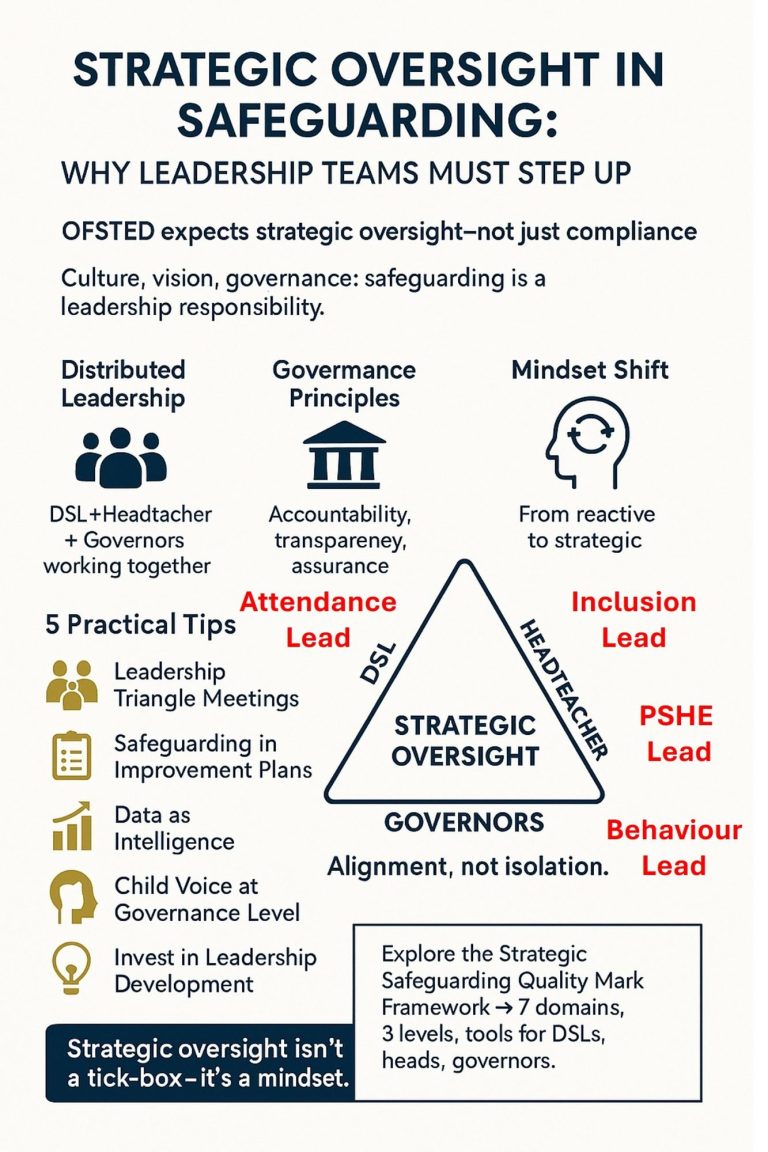
Safeguarding leadership often defaults to the Designated Safeguarding Lead (DSL). But OFSTED’s wording suggests something bigger: a leadership team approach. Strategic oversight cannot sit with one person—it requires DSL, headteacher, and governors working together with clarity and purpose. Also at times needs to include other leads such as attendance, behaviour, inclusion and also PSHE Lead.
Safeguarding is not just compliance—it’s culture, vision, and governance. And that means leadership teams must step up.
### Leadership Theory: Distributed Leadership and Governance Principles
**Distributed Leadership** argues that leadership is most effective when responsibilities are shared across a team rather than concentrated in one role. In safeguarding, this means DSLs, headteachers, and governors each bring unique expertise to create a holistic approach.
**Governance Principles** emphasize accountability, transparency, and assurance. Boards must move beyond compliance checks to ask deeper questions about culture and impact. Strategic safeguarding aligns perfectly with these principles, ensuring that leadership decisions are informed by evidence and lived experience.
### Operational vs Strategic: The Tension
- DSLs are buried in casework and statutory returns.
- Headteachers juggle improvement priorities and resource pressures.
- Governors often rely on dashboards and reports without probing deeper.
Result? Oversight becomes reactive, not strategic.
### What Strategic Oversight Looks Like
Strategic oversight is about leadership alignment:
- DSL: Brings frontline intelligence and trends to inform leadership decisions.
- Headteacher: Aligns safeguarding with school improvement priorities and culture.
- Governors: Provide challenge and assurance—asking about impact, not just compliance.
- Inclusion Lead: supports the bespoke support for children with SEND
- Behaviour Lead: supports trauma informed approaches to behaviour and bespoke plans
- Attendance Lead: ensure attendance is seen as a safeguarding concern and appropriate support can be put in place which is bespoke
- PSHE Lead - support the delivery of an effective safeguarding curriculum based on contextual information and risk
Key questions for boards:
- How do we know safeguarding is lived, not laminated?
- What evidence shows children feel safe and listened to?
### Five Practical Tips for Leaders
1. **Create a Safeguarding Leadership Triangle + **
Schedule termly strategic safeguarding meetings with DSL, headteacher, and governor link. Focus on trends, culture, and improvement—not just incidents. (invite ofther leads to add to your triangle)
2. **Embed Safeguarding in School Improvement Plans**
Make safeguarding a golden thread in development priorities. Link actions to pupil wellbeing and engagement, not just compliance.
3. **Use Data as Intelligence**
Move beyond raw numbers. Analyse patterns—attendance dips, exclusions, family support needs—and discuss what they mean for strategy.
4. **Prioritise Child Voice at Governance Level**
Include pupil feedback in safeguarding reports. Governors should ask: What do children say about feeling safe?
5. **Invest in Leadership Development**
DSLs need strategic leadership skills, not just operational expertise. Governors need confidence to challenge and support nut sadly when researching, I found little comprehensive guidance on what strategic safeguarding looks like in practice. Most resources stop at compliance.
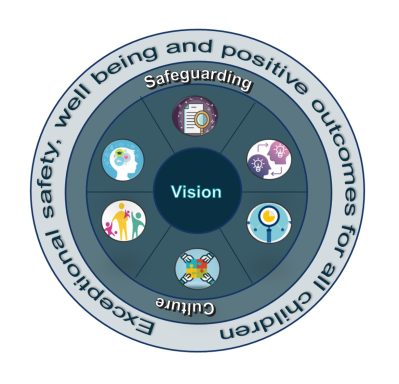
That gap motivated me to create the **Strategic Safeguarding Quality Mark Framework**, which codifies strategic safeguarding across seven domains—giving leaders a roadmap to strengthen oversight and move beyond ‘expected and inspected.’
The framework:
- Defines seven domains of strategic safeguarding (culture, policy, data, staff understanding, partnerships, family support, curriculum).
- Provides clear descriptors at three levels: Foundational, Enhanced, Transformative.
- Offers self-evaluation tools and developmental support for DSLs, headteachers, and governors as a team.
### Closing Thought
Strategic oversight isn’t a tick-box—it’s a mindset. It’s about leadership teams asking the right questions, shaping culture, and ensuring safeguarding is not just a statutory duty but a lived reality for every child.
If you want to explore what this looks like in practice, you can learn more about the framework [here]
(https://www.lefevre-solutions.co.uk/strategicsafeguarding-quality-mark/)
or contact me at jon@lefevre-solutions.co.uk.
We need your consent to load the translations
We use a third-party service to translate the website content that may collect data about your activity. Please review the details in the privacy policy and accept the service to view the translations.